Couples & relationships
When Couple Counseling Can Help You Reconnect
Published 6 min read

By the CGO Clinical Team
Licensed counselors and social workers in Springfield, MO · Meet the team
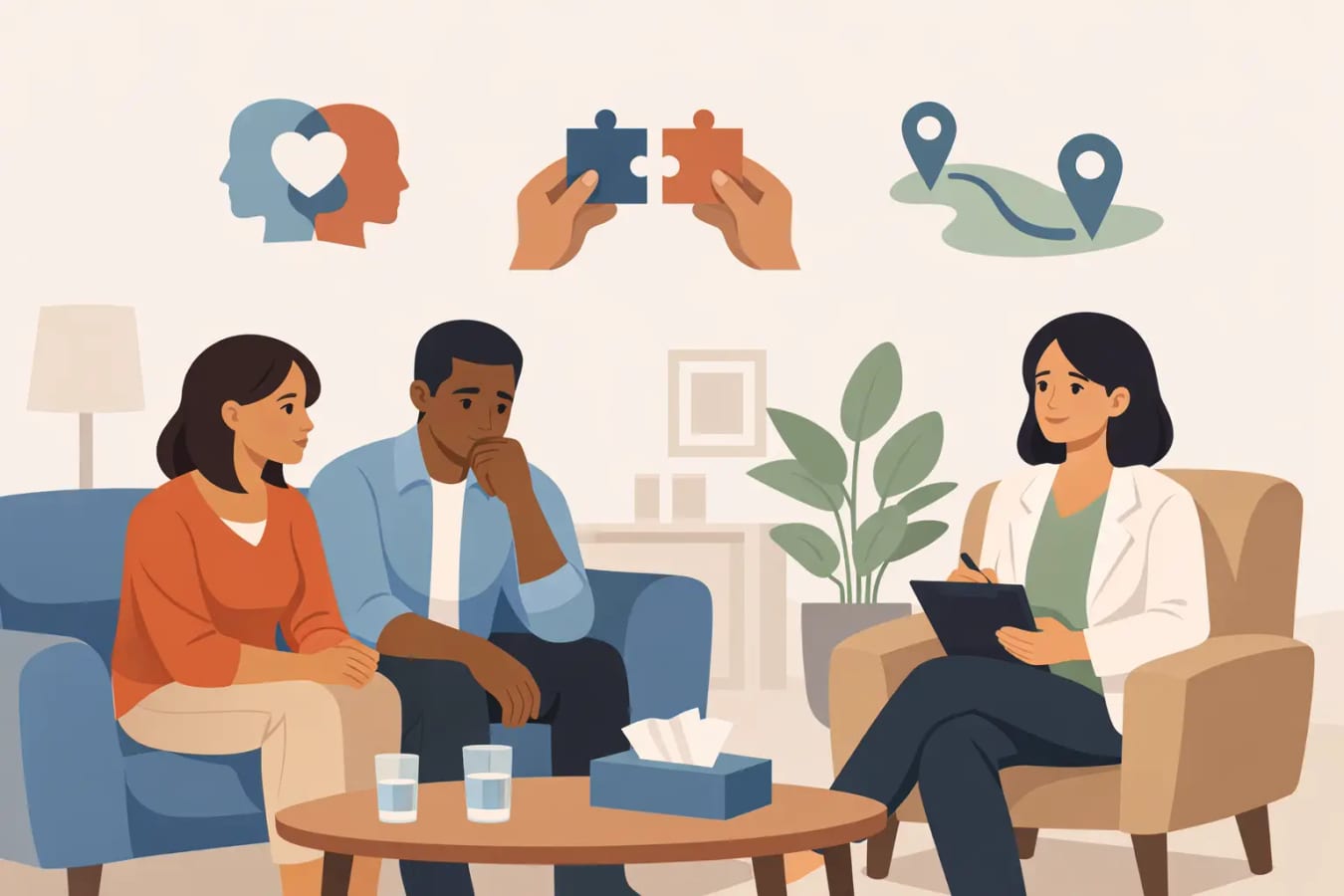
The same argument can begin to feel painfully familiar: one person asks for more connection, the other pulls away, and both leave the conversation feeling unheard. Or perhaps the silence between you has become heavier than the conflict. Couple counseling creates a protected space to slow that pattern down, understand what is happening beneath it, and decide what a healthier path forward could look like.

Seeking support does not mean your relationship has failed. It can mean you care enough about yourself, your partner, and the life you share to try something different. Many couples reach out when the ways they have always handled stress, disagreement, or hurt are no longer bringing relief.
What couple counseling is really for
Couple counseling is a form of therapy that helps partners examine their relationship with the guidance of a trained mental health professional. The goal is not to determine who is right, force quick forgiveness, or make every disagreement disappear. It is to help both people feel heard, build a clearer understanding of their patterns, and develop more workable ways to communicate and respond to one another.
A counselor brings structure to conversations that may otherwise become circular, defensive, or shut down altogether. They can help name what is happening in the moment: criticism that is covering fear, withdrawal that is protecting someone from feeling overwhelmed, or a recurring disagreement that is really about trust, security, respect, or shared responsibility.
This work can support couples at many stages. Some come in after a major rupture, such as infidelity, a painful breach of trust, financial secrecy, or a significant life change. Others want help before resentment grows deeper. Couples may also seek counseling while adjusting to parenthood, blending families, caring for aging relatives, grieving a loss, navigating differences in intimacy, or making decisions about the future.
There is no single issue that is "serious enough" to deserve care. If the relationship feels persistently difficult, lonely, tense, or stuck, that is reason enough to consider support.
Signs it may be time for couple counseling
People often wait until the relationship is in crisis because they assume counseling is only for couples on the edge of separation. Counseling can be valuable then, but earlier support may give you more room to understand each other before hurt becomes more entrenched.
It may be time to talk with a counselor if conversations repeatedly turn into fights, or if one or both of you avoid difficult topics because the outcome feels predictable. You might feel more like roommates than partners, struggle to repair after conflict, or notice that small problems quickly become evidence that the relationship is unsafe or hopeless.
Trust concerns are another common reason to seek care. Trust can be affected by betrayal, dishonesty, broken promises, emotional distance, substance use, spending, secrecy, or years of feeling dismissed. Rebuilding it is usually not a matter of one apology or one reassuring conversation. It takes honesty, consistent behavior, and space for the injured partner's experience to be taken seriously.
Sometimes the clearest sign is not frequent conflict but the absence of connection. You may still function well as a household, parent effectively, and care about each other deeply while feeling emotionally far apart. That distance deserves attention too.
What happens in couple counseling sessions
The first sessions usually focus on learning the story of your relationship and what brings you in now. A counselor may ask about your strengths as a couple, the conflicts that recur, how you each experienced your family growing up, current stressors, and what you hope will be different. Both partners should have room to share their perspective without being treated as the problem.
From there, the work depends on your needs. You may practice having a difficult conversation without interrupting, escalating, or disappearing emotionally. You may learn how to identify the feelings underneath anger, make direct requests instead of assumptions, and respond to one another with more curiosity. Some couples need help setting boundaries with work, family, technology, or former partners. Others need to address long-standing pain that has not been safely discussed.
Counseling is not about asking you to tolerate behavior that harms you. A responsible clinician will pay attention to emotional and physical safety, coercion, intimidation, and control. When there is active abuse or fear, joint sessions may not be the safest or most appropriate starting point. Individual support, safety planning, or specialized resources may be needed instead.
You do not have to agree on everything
Healthy relationships are not built on identical personalities, backgrounds, beliefs, or needs. Couples often differ in how they handle money, closeness, conflict, sex, parenting, faith, social time, and stress. The question is not whether differences exist. It is whether you can approach those differences with respect and create agreements that honor both people.
A good counseling space makes room for each partner's individuality. Your race, age, sexual orientation, gender identity, culture, faith, financial circumstances, and lived experiences can shape how you understand relationship and family. Those realities should be treated with dignity, not brushed aside.
How to get more from the process
You do not need to arrive with perfect words or a complete plan. Still, a few attitudes can make counseling more useful. Try to come with a willingness to look at your own part in the pattern, even when you are carrying legitimate hurt. This is different from accepting blame for everything. It means being open to understanding how your responses may affect the cycle between you.
It also helps to be honest about what you want. Some couples hope to repair and deepen the relationship. Some are uncertain whether they can continue. Others need support having difficult conversations about separation, co-parenting, or a changed future. Counseling can provide clarity, but it cannot ethically promise a particular outcome.
Progress is rarely perfectly linear. A session may bring relief because something finally feels understood. Another may stir up sadness, anger, or uncertainty because you are discussing an issue that has been avoided for a long time. That does not automatically mean therapy is making things worse. It can mean you are beginning to face something important, with support. If the pace feels too fast, too slow, or emotionally unsafe, say so. The therapeutic relationship should allow room for that conversation.
Between sessions, change often happens in small, repeatable choices: pausing before responding, checking an assumption, offering a genuine repair, or returning to a conversation after taking time to regulate. These moments can seem modest, but they gradually create evidence that the relationship can feel different.
Choosing a counselor for your relationship
The right fit matters. Look for a licensed clinician with experience working with couples and a style that feels respectful to both of you. You deserve a counselor who can be compassionate without taking sides, direct without shaming, and attentive to the values and identities that matter in your relationship.
Practical concerns matter too. Consider scheduling, cost, insurance options, and whether in-office or online sessions would make care easier to sustain. For couples in the Springfield, Missouri area, having a local option can be helpful, while telehealth may offer needed flexibility when it is appropriate for your circumstances.
At Counseling Group of the Ozarks, care is grounded in the belief that people deserve to be seen as whole individuals, not reduced to a conflict or diagnosis. That same respect matters in relationship work: both partners deserve emotional safety, honesty, and a meaningful opportunity to be understood.
You may not know yet whether your relationship needs repair, clearer boundaries, a new way of communicating, or help making a difficult decision. You do not have to know before you begin. Reaching for support can be a brave first step toward treating yourselves, and each other, with the care you both deserve.