
Emotional health
Therapy or Psychiatry for Depression: Which Helps?
Published 6 min read

By the CGO Clinical Team
Licensed counselors and social workers in Springfield, MO · Meet the team
Depression can make even a simple decision feel heavy. If you are wondering about therapy or psychiatry for depression, you do not have to choose perfectly before asking for help. The right starting point is often the care that feels accessible, safe, and possible right now.
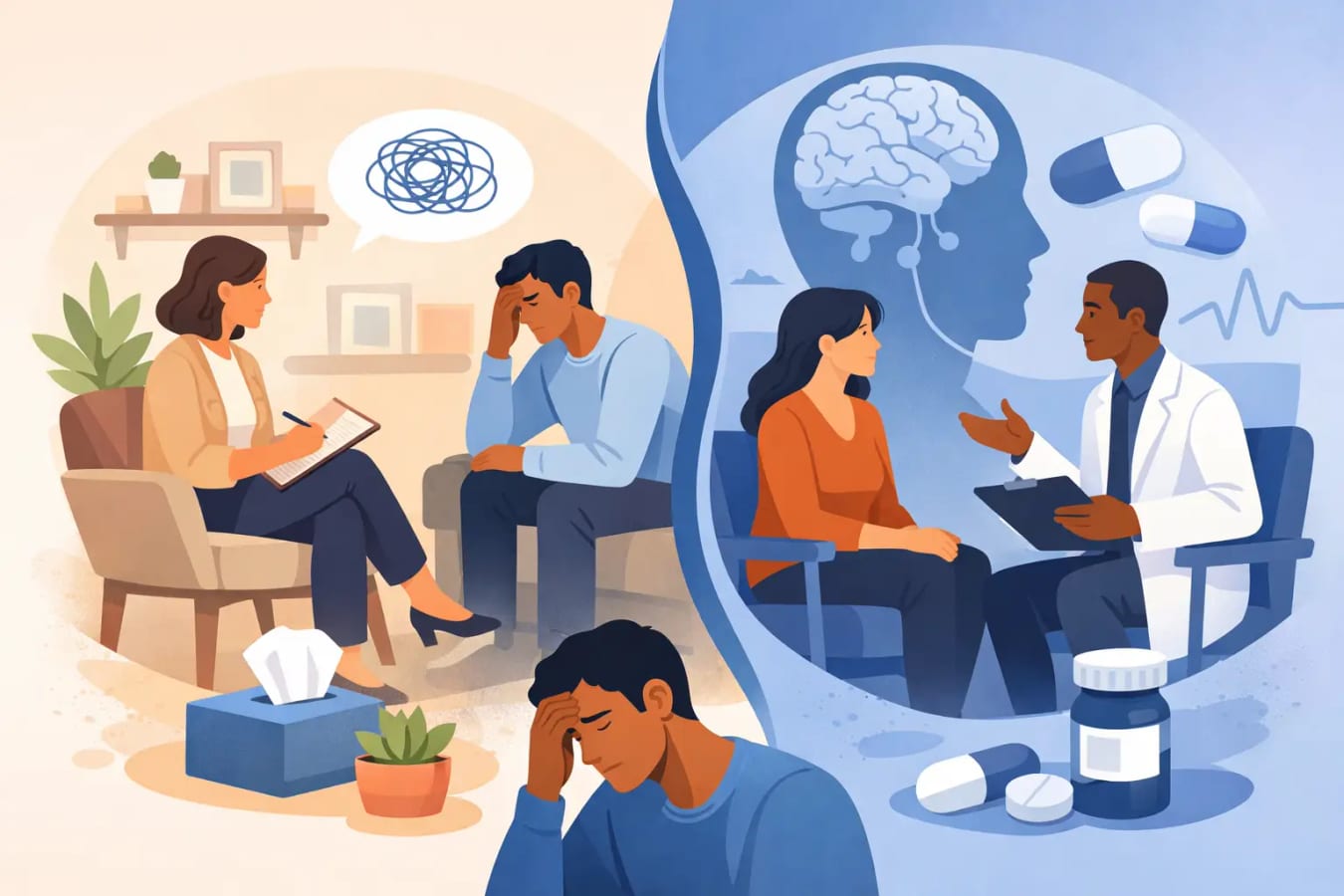
Some people benefit most from talking with a therapist. Others need medication support, either for a season or longer. Many find that a combination of both offers the clearest path forward. None of these choices says anything negative about your strength, character, or ability to cope. Depression is not a personal failure. It is a real health concern that deserves thoughtful, compassionate care.
Therapy or Psychiatry for Depression: The Difference
Therapy and psychiatry are both forms of mental health care, but they serve different roles.
Therapy, also called counseling or psychotherapy, provides a consistent space to talk through what you are experiencing with a trained mental health professional. A therapist can help you understand patterns in your thoughts, emotions, relationships, and daily life. Together, you may work on practical coping skills, process painful experiences, set boundaries, improve communication, or reconnect with parts of yourself that depression has made difficult to reach.
Psychiatry is medical care for mental health. Psychiatrists are physicians who can evaluate symptoms, consider medical factors, diagnose mental health conditions, and prescribe medication when appropriate. In some settings, a psychiatric nurse practitioner or primary care physician may also provide medication management for depression.
Neither approach is inherently “more serious” than the other. Therapy is not only for mild depression, and medication is not a sign that someone has failed at therapy. The decision depends on your symptoms, health history, preferences, resources, and what support is available to you.
When Therapy May Be a Good First Step
Therapy can be especially helpful when depression is connected to grief, relationship stress, burnout, a major life transition, trauma, isolation, identity-related stress, or a sense that your life no longer feels like your own. It can also help when you cannot identify one clear cause. Depression is often complex, and you deserve room to explore that complexity without judgment.
A therapist may use approaches such as cognitive behavioral therapy, which helps you notice and gently challenge unhelpful thought patterns, or interpersonal therapy, which focuses on relationships and life changes. Other approaches may center trauma, emotions, values, family systems, or the connection between your body and your mental health. The most helpful approach is not always the one with the most technical name. It is often the one that fits your needs and is offered by someone you can gradually learn to trust.
Therapy asks for time and participation, but it does not require you to arrive with the right words. You can begin by saying, “I do not feel like myself,” “Everything takes too much effort,” or “I am tired of pretending I am okay.” That is enough to begin.
For many people, therapy is a meaningful first choice when they can still manage daily responsibilities, even if doing so feels difficult, and when they want support understanding what is beneath their depression. It can also be a strong option for people who prefer to try non-medication treatment first.
When Psychiatry May Be Worth Considering
Medication can reduce symptoms that make it hard to function, connect, sleep, eat, work, attend school, or participate in therapy. It may be worth discussing psychiatric care if depression feels persistent, severe, or physically consuming.
Some signs that a medication evaluation could be helpful include significant changes in sleep or appetite, frequent crying or numbness, difficulty getting out of bed, inability to focus, loss of interest in nearly everything, or depression that has not improved with therapy or self-care efforts. A history of recurrent depression, bipolar disorder in you or your family, postpartum depression, or depression alongside anxiety may also be useful information to share with a prescriber.
A psychiatric evaluation does not obligate you to take medication. It is a conversation about options. A good prescriber should listen to your concerns, explain potential benefits and side effects in plain language, consider your physical health and other medications, and make space for your questions.
Antidepressants can be very helpful for some people, but they are not instant. Many take several weeks to show their full effect, and finding the right medication or dose can involve adjustments. Side effects are possible, and they should be taken seriously. You have the right to speak up if something does not feel right, and you should not stop a prescribed medication suddenly without discussing it with your prescriber.
Why Combined Care Often Helps
For moderate to severe depression, therapy and medication together can be a powerful combination. Medication may ease the intensity of symptoms enough that it becomes easier to use the tools you are learning in therapy. Therapy can then help you build insight, skills, support systems, and self-understanding that medication alone may not provide.
Combined care is not required for everyone. Some people improve significantly with therapy alone. Others find medication management through a trusted medical provider is their most immediate need. The goal is not to follow someone else’s formula. The goal is care that respects your experience and helps you move toward relief.
When possible, it can be helpful for your therapist and prescriber to coordinate care with your written permission. They do not need to agree on every detail, but shared information can help ensure that your emotional and medical needs are being considered together.
Questions That Can Help You Decide
You do not need to diagnose yourself to make a first appointment. Still, a few questions may bring some clarity: How much is depression affecting my ability to live my daily life? Have I experienced these symptoms before? Do I want help processing emotions or changing patterns in my life? Am I open to discussing medication, even if I am unsure about taking it?
Your practical circumstances matter, too. Availability, insurance coverage, transportation, privacy, and scheduling can all influence what kind of care is realistic. Online therapy may make consistent support more accessible, while an in-office setting may feel more grounding to someone else. There is no shame in choosing the option you can begin now.
It is also okay to start with therapy and add psychiatric support later, or to begin with a medical evaluation and seek therapy afterward. Depression can change over time, and your care plan can change with it.
Finding Care That Feels Respectful
The relationship with your provider matters. You deserve a therapist or prescriber who treats you as a whole person, not a diagnosis or a checklist. Your race, age, culture, faith, sexual orientation, gender identity, family background, finances, and lived experiences can shape how depression feels and what healing needs to look like. Respectful care makes room for all of that.
At Counseling Group of the Ozarks, therapy is approached as a collaborative process. You do not have to perform wellness, explain everything perfectly, or minimize what hurts to be worthy of support. Whether you are seeking in-office counseling in Springfield, Missouri, or online care, the first conversation can simply be a place to tell the truth about how hard things have been.
If Depression Feels Urgent
If you are thinking about hurting yourself, feel unable to stay safe, or believe you may act on suicidal thoughts, seek immediate support. Call or text 988 in the United States to reach the Suicide & Crisis Lifeline, call 911, or go to the nearest emergency room. If you can, tell someone you trust and avoid being alone while you get help.
You do not have to wait until depression becomes a crisis to reach out. Choosing therapy, psychiatry, or both can be a practical act of courage. The next step does not have to solve everything. It only has to bring you a little closer to support, safety, and the possibility of feeling more like yourself again.